


Many thanks to all of you (944!) who participated in the 2019/2020 AAALAC International Survey of Accredited Organizations conducted through our research partner, EurekaFacts. The response rate speaks to your dedication and commitment to participating in, and supporting, the accreditation program. We appreciate your time and will use your feedback to inform future activities and continue to refine AAALAC’s program and processes to better serve you!
For those interested, here are a few take-a-ways from the survey findings…
The vast majority of accredited program participants report they are “very satisfied” with AAALAC’s overall program, the accreditation process, and AAALAC staff communications. Overall, about eight-in-ten (83%) respondents say they are “very satisfied” with the accreditation program. Likewise, 80% are very satisfied with the accreditation process (both initial and/or renewal) and 84% are very satisfied with the communication they have had with AAALAC staff.
The last comprehensive survey of accredited programs took place in 2006. Since then, great strides in site visit performance in key areas were reported:
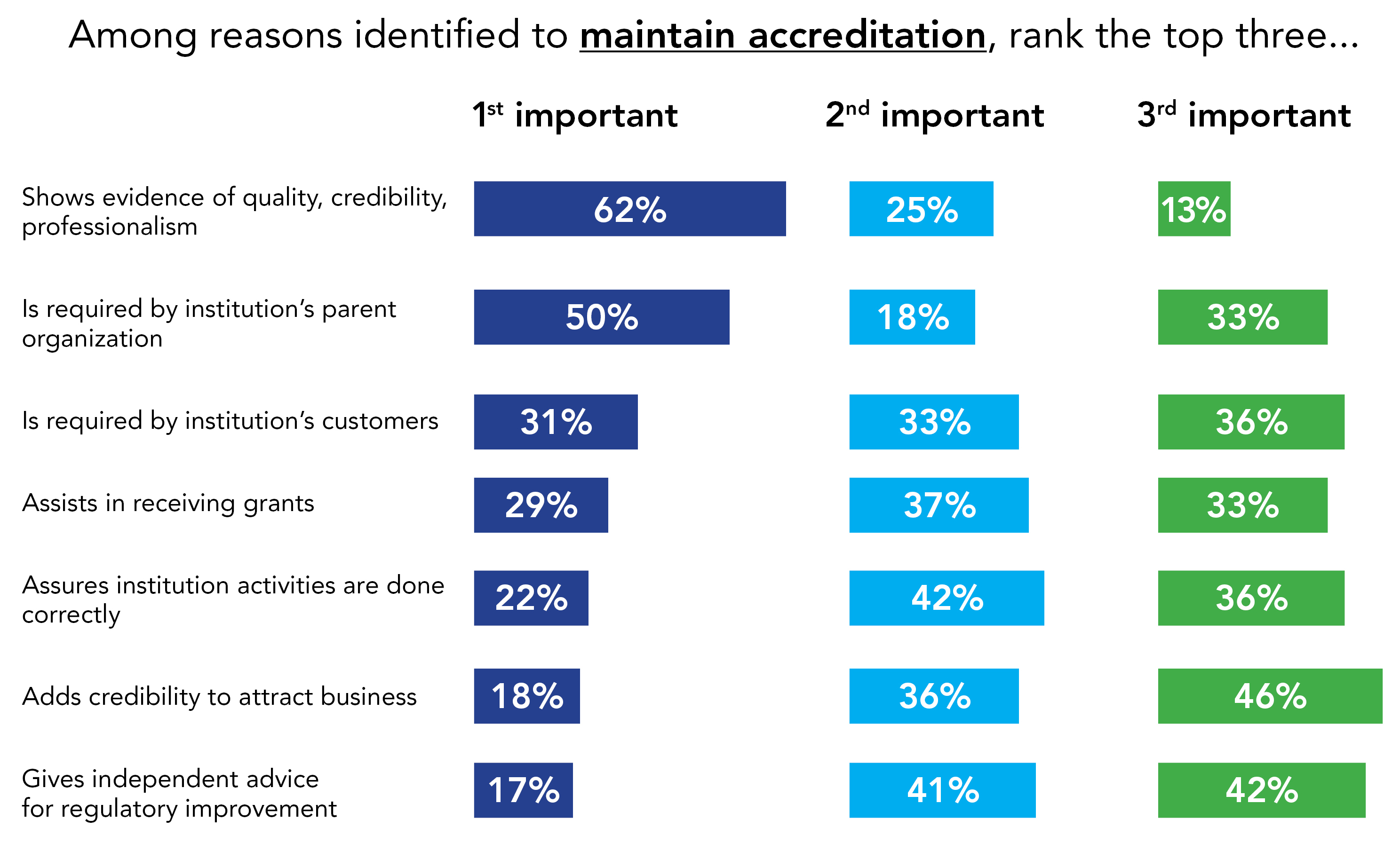
Respondents noted a multitude of reasons why maintaining AAALAC accreditation is important to them and their institutions. Top reasons include…
A majority in the U.S. also say that accreditation assists with receiving a variety of grants (only a minority of those in programs in Asia (15%) or Europe (11%) say the same). Two thirds of contract research laboratories note that AAALAC accreditation is maintained because it is required by customers.
Here’s how you ranked the reasons to maintain accreditation by importance:
We asked you to rank the benefits of participating in the accreditation program. High on the list is that it is very important that AAALAC accreditation “conveys professionalism to the scientist community” (87%); displays a “positive public image and validates a program’s high standards” (86%); and that AAALAC’s standards “ensure high quality research” (79%).

Your responses helped us identify areas where we will look to improve our processes and communications…
Program Description process
Although few respondents described maintaining accreditation as burdensome, the survey did identify some areas where there may be room for improvement. Among those respondents who suggested areas to examine for improvement, most mentioned the Program Description, which was described as requiring redundant information and intensive labor. AAALAC will critically evaluate the current Program Description and look for ways to reduce administrative burden associated with completing the Program Description, such as making it easier to transfer material from previous Program Descriptions to new ones.
Applying accreditation standards
Although a majority of respondents indicated that AAALAC’s standards are applied consistently across institutions (76%), some respondents suggested further enhancing the consistency in the application of standards used in the accreditation process. AAALAC will review this feedback in the context of the Council on Accreditation’s current program to foster consistency in its work and in the manner in which AAALAC communicates how standards are applied.
More web-based educational opportunities
More than eight-in-ten respondents indicated an interest in educational PowerPoint® slides on standards and Reference Resources (85%), and almost half rated this as their greatest interest in terms of educational tools. Likewise, many (83%) are interested in briefing publications on the latest animal care related topics. AAALAC is currently expanding its library of materials and will continue to look for ways to expand these types of offerings.
Social media communications
While ratings for AAALAC’s website and email communications scored high, when it comes to communication via social media a slim majority are “very satisfied” with “posts/notifications on the AAALAC Twitter account” (55%) and about six-in-ten (59%) express this level of satisfaction with the post/notifications on AAALAC’s Facebook page. AAALAC will explore ways to improve its social media content and presence.
In the months ahead AAALAC will continue to process the results of the survey and make and implement plans to address areas flagged for improvement. Thank you again for your thoughtful participation and your ongoing commitment to high-quality animal care and use and science!
Questions regarding the survey may be sent to lwieder@aaalac.org.