

There will be a security update made on the AAALAC server between 1 AM and 4 AM EDT Friday, October 16, 2026.
Users may experience up to 10 minutes of downtime as the patch is applied and services are restarted.

The Primary Standards will move to the Reference Resources. While the Rules of Accreditation establish AAALAC International's accreditation requirements, the Guide for the Care and Use of Laboratory Animals remains an important reference resource used by the Council on Accreditation during the accreditation process. Click here for more details on this update.
AAALAC International is not a regulatory body and does not make or enforce regulations. Instead, the AAALAC Council on Accreditation relies on the AAALAC International standards as set forth by the Rules of Accreditation to evaluate animal care and use programs. These standards include applicable Legislation/Regulations, AAALAC Position Statements, Guidance Statements, and Reference Resources. Council has also developed a list of answers to “Frequently Asked Questions” to further clarify administrative processes.
Each of these is described below. For additional detail, download the i-brief on "AAALAC International standards: The review and adoption process explained."
The Rules of Accreditation are approved by the AAALAC Board of Directors and define the organization’s requirements for accredited animal care and use programs. The Rules charge the Council on Accreditation with establishing the process used to evaluate accredited programs and applicants. As part of that responsibility, the Council has developed a portfolio of standards that includes applicable Legislation/Regulations, Position Statements, Guidance Statements, and Reference Resources.
Accreditable units are expected to comply with implementing legislation that applies to all areas of the animal care and use program in the country or region where they are located. These serve as the foundation, along with Primary Standards, as the basis for program evaluation. Accredited programs are expected to comply with the strictest of the two standards, and with the recommendations of the Primary Standards for topics not well addressed in the legislation.
AAALAC International publishes Position Statements that are used as supplemental requirements and recommendations in dealing with certain issues, such as adequate veterinary care, standards for the use of farm animals, and occupational health and safety. Position Statements are developed by Council to provide in-depth guidance on AAALAC’s expectations regarding these aspects of an animal care and use program. Position Statements provide enduring direction for the Council and the accreditation community on key aspects of animal care and use. Click here to review the Position Statements.
This is a new category of standards that was approved by the Council in early 2025. AAALAC International publishes Guidance Statements that are developed by AAALAC and provide clarification on Council’s interpretation of expectations for specific aspects of accreditation. Click here to review the Guidance Statements.
AAALAC’s Council also refers to other specialty publications for supplemental information about procedures or techniques related to the care and use of laboratory animals. These specialty publications are called Reference Resources. These references have been formally reviewed and adopted by AAALAC’s Council on Accreditation as guidance for accredited units and may be referred to by Council members in evaluating programs.
Resources are categorized into:
The Council on Accreditation has developed answers to Frequently Asked Questions (FAQs) to provide additional clarification on the accreditation process.
The Rules of Accreditation outline eight (8) guiding principles that must be present in an animal care and use program. In order to assist units in finding all of the AAALAC standards that apply to a particular topic, the Office has also organized the portfolio of standards by the guiding principles.
In this 17-minute video, AAALAC's Chief Accreditation Officer, Dr. Debra Hickman, explains how AAALAC's Council on Accreditation evaluates programs and how their accreditation standards framework operates in practice...
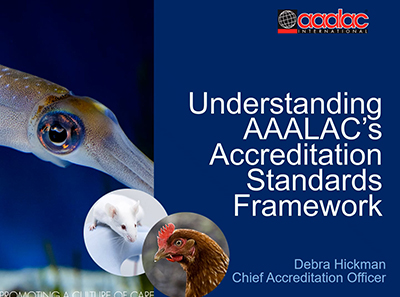
Understanding AAALAC's Accreditation Standards Framework
(PowerPoint with audio)
For additional detail, download the i-brief on "AAALAC International standards: The review and adoption process explained."